

Using Electrical Bursts to Get the Gut Moving
Bursts of electrical stimulation could help restore gut motion to treat constipation, a technique recently licensed by industry leader Boston Scientific
Whether it’s developing new technologies or pioneering new areas, Duke Biomedical Engineering is a leading force driving the discoveries and innovations that help clinicians save lives.
It has been another productive year for the Duke BME community!
From increasing the department’s research expenditures to a long list of faculty accolades and impactful discoveries, Duke BME continues to build on its historical strengths while opening new frontiers in emerging technologies. Patient-specific models of brain activity to guide the hands of neurosurgeons. Repurposing the powerful CRISPR gene-targeting system to explore and manipulate the epigenome. Harnessing the abilities of large language models to design and build new proteins and nanoparticles for life-changing therapies.
Please join me in celebrating our many accomplishments from the past year and exploring the exciting potential of our newest faculty and research and education programs.

Creating a Community of Support in the Classroom

Using Robotics to Speed Up Cellular Evolution

Decoding How Cells Interact and Organize

Exploring New Methods to Diversify and Strengthen Engineering Education

Using AI to Map and Design New Proteins

Improving Ultrasound’s Abilities to Detect and Study Disease

Manipulating the Microbial Interactions in our Guts
NSF CAREER Award

Sony Women in Technology Award with Nature and Presidential Early Career Award for Scientists and Engineers (PECASE)

Society of Biomaterials Technology Innovation and Development Award

Fulbright Global Scholar Award

2025 Young Innovator in Cellular and Molecular Bioengineering (CMBE)

Clarivate Highly Cited List

IEEE EMBS Early Career Achievement Award

AIUM’s William J. Fry Memorial Lecture Award, IEEE Fellow

ASEE Biomedical Engineering Teaching Award

AIMBE College of Fellows, SPIE Fellow, IC-UEBA Young Investigator Award
Bursts of electrical stimulation could help restore gut motion to treat constipation, a technique recently licensed by industry leader Boston Scientific

The new approach allows researchers to identify and optimize material recipes to more effectively encapsulate difficult-to-deliver drugs

New approach uses bacterial genes to restore both strength and rhythm of damaged hearts.

Discovering the link between congenital heart disease and kidney problems could improve outcomes for patients with the disease
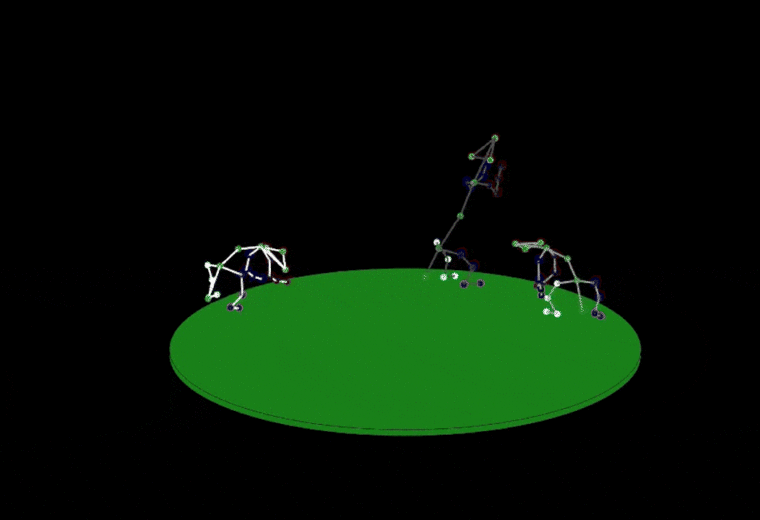
A new platform uses machine learning to identify and map social interactions, unlocking new ways to study behavioral disorders like autism

Researchers find a master epigenetic switch that activates silenced genes to compensate for their missing counterparts in a rare genetic disease called Prader-Willi syndrome

Led by Charlie Gersbach, CAGT published a paper in Science explaining how cells sense their mechanical environment, opening new paths for treating disease.
CAGT’s work has led to the launch of Tune Therapeutics, a startup focused on modulating the epigenome to treat disease that recently raised $175M in Series B financing.
Launched this year by Amanda Randles, CDHI applies data-driven approaches to enhance diagnosis, treatment and prevention of disease.
The center focuses on themes such as using patient-specific digital twins to inform clinical decision-making and wearable technology data to predict developing diseases before symptoms appear.

Co-led by Jessilyn Dunn, this new center will expand community partnerships and co-create research in support of rural North Carolinians, including rural-specific chronic disease epidemiology, implementation science to improve the uptake of screening and treatment in rural clinics, and community-guided intervention studies that reflect local values and realities.
